What Is Walk-Forward Analysis? Escaping the Past-Optimization Trap
April 2026
The biggest weakness of a simple backtest is that “one pass over the whole history” tends to become curve-fitting to the past, unreplicable in the future. Walk-forward analysis (WFA) applies a cross-validation mindset to time series.
Basic Structure
| Phase | Period | Role |
|---|---|---|
| IS (In-Sample) | e.g. 2018–2020 | Parameter optimization |
| OOS (Out-of-Sample) | e.g. 2021 | Live-like check of optimized parameters |
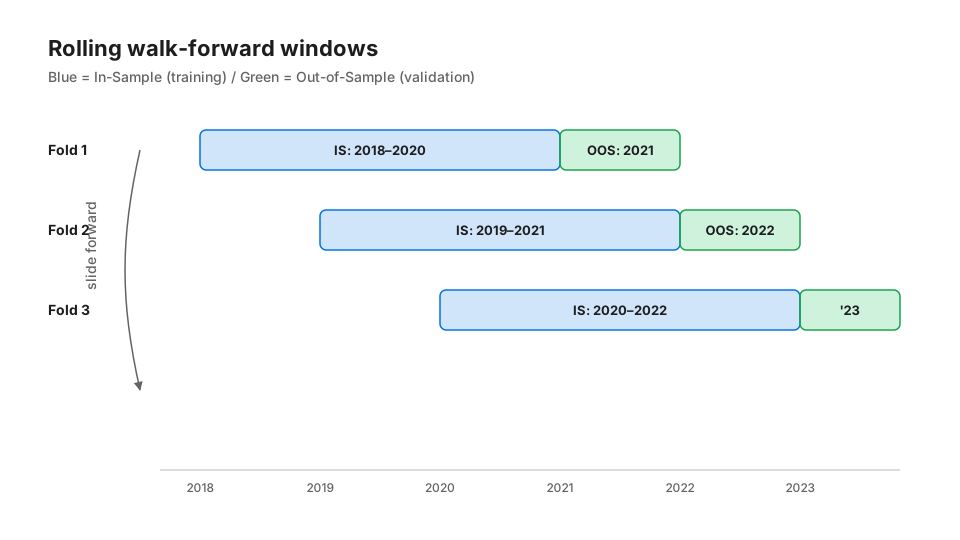
WFA rolls the window forward repeatedly: optimize on 2018–2020, test on 2021; then optimize on 2019–2021, test on 2022; and so on.
Two Flavors
- Rolling WFA: keep IS length constant, slide the window
- Anchored WFA: fix the start date, extend IS as new data arrives
Anchored assumes “more data is strictly better.” If you care about structural regime change, Rolling is better; if you care about stable long-run averages, Anchored fits.
What to Look For
- IS vs. OOS gap. A large gap signals overfitting
- OOS variability. Are per-window OOS returns consistent?
- Parameter stability. A system whose “optimal” parameters jump every window has poor robustness
Practical Notes
WFA is computationally heavy — instruments × parameter grid × number of windows explodes fast. A practical recipe is coarse grid first, then refine in the promising region.
OOS periods that are too short are dominated by luck. As a rule of thumb, ensure each OOS window contains at least several dozen trades.
The WFA mindset complements spotting overfitting — read the two together.
Try It in QuanTest
QuanTest supports training/testing period separation. Start with one strategy, a handful of parameters, and 2–3 windows, and feel the gap between IS and OOS directly.
Free · No signup · Data stays on your device
This article is for educational purposes. It does not guarantee the profitability of any strategy or future performance. Investment decisions are your own responsibility.