Sharpe vs. Sortino: Understanding How "Downside Risk" Changes the Verdict
April 2026
Strategy comparisons constantly reference Sharpe and Sortino ratios. Both are “return ÷ risk,” but they define risk differently.
Definitions
| Metric | Denominator | What it treats as risk |
|---|---|---|
| Sharpe | Stdev of all returns | Both up and down volatility |
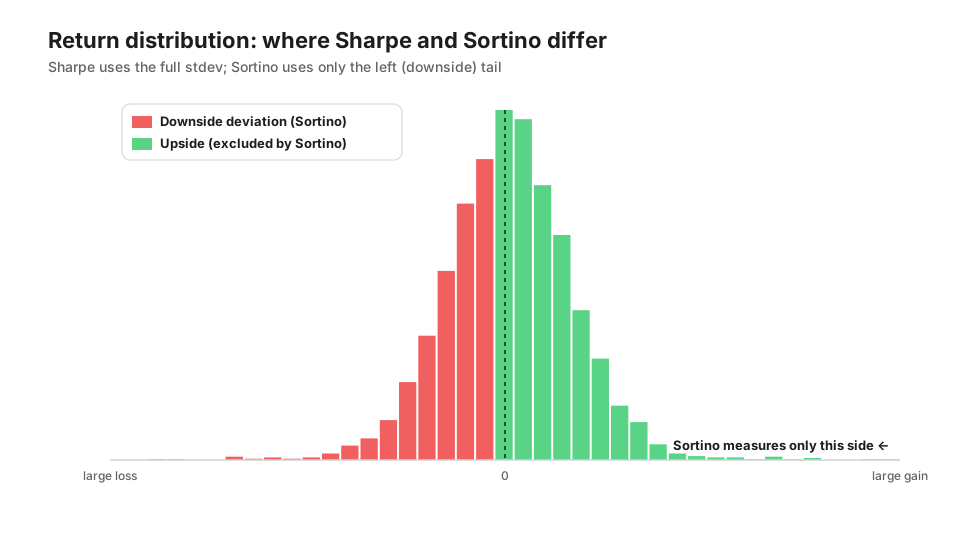
| Sortino | Downside deviation (stdev of negative returns only) | Only downside volatility |
Both numerators are “return − risk-free rate.” Higher is better.
Why Two Metrics?
The most common critique of Sharpe: it penalizes upside surprises equally with downside ones. That offends intuition — investors don’t mind sharp gains.
Sortino addresses this by using only downside deviation. Strategies with frequent upside spikes tend to score higher on Sortino than on Sharpe.
When to Use Which
- Roughly normal returns. Sharpe is fine — and it’s the industry default for comparisons
- Skewed returns. Strategies like short options (“many small wins, rare large losses”) are better reflected by Sortino
- Momentum strategies. Upside-heavy profiles are underrated by Sharpe alone
Caveats
Both metrics are unstable with small samples. One or two years of backtest data is dominated by noise. Use a few hundred trades as a minimum before letting these numbers drive decisions.
Risk-free rate treatment varies by convention. Approximating 0 is fine for Japanese equity testing, but becomes non-trivial when benchmarking against U.S. or global assets.
Neither ratio captures max drawdown information. A high Sharpe with a deep DD is psychologically unsustainable. Consider Calmar (return / max DD) as a complementary metric.
A full view of what to watch when comparing backtests is in this article.
Try It in QuanTest
QuanTest displays Sharpe and Sortino side by side in the results panel. When they diverge significantly, the return distribution likely has meaningful skew — worth plotting as a histogram.
Free · No signup · Data stays on your device
This article is for educational purposes. It does not guarantee the profitability of any strategy or future performance. Investment decisions are your own responsibility.