Why Ignoring Fees and Slippage in Your Backtest Is Dangerous
April 2026
The first time you wire up a backtest, it usually runs with zero fees and zero slippage. If you choose strategies from that result without moving closer to reality, short-term strategies in particular will mislead you badly.
Three Cost Components
| Component | Typical (Japanese equities) | Impact |
|---|---|---|
| Broker commission | 0–0.1% per side | Small with modern brokers |
| Slippage | 0.05–0.2% per side | Depends on liquidity and order book |
| Execution timing | Gaps can move 1%+ | Open vs. close matters |
Commissions vary by plan, but slippage is the hidden cost you have to estimate yourself.
Estimating Slippage
Slippage is the gap between theoretical and actual execution prices. Common models:
- Volume / depth ratio. Your order size as a fraction of book depth
- ATR-based. 5–10% of ATR as slippage
- Fixed bps. 3–10 bps per side for liquid large caps, 20+ bps for small caps
A realistic approach combines ATR-based + book depth awareness.
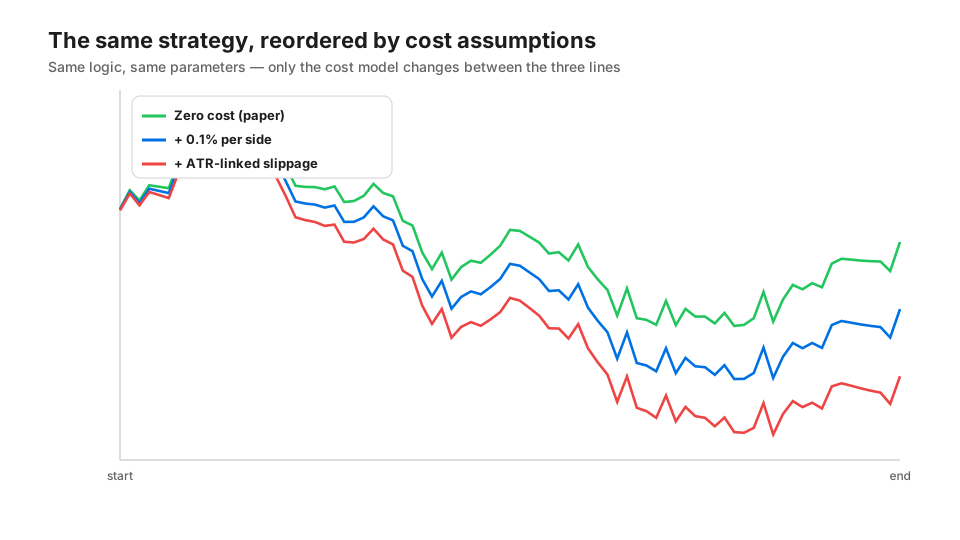
How Costs Reorder Strategies
Short-term strategies see their ranking flip when costs are applied. Example:
- Zero cost: CAGR +15%, 500 trades
- 0.1% per side: CAGR +5%
- ATR 10% slippage added: CAGR −3%
Strategies that look profitable before costs and negative after exist in real data. Without testing for this, paper-profitable systems die in production.
Tick Sizes and Gaps
Japanese equities have tick sizes that step up with price, and opening gaps are routine. If your backtest assumes market-on-open, check whether gap behavior is properly absorbed.
Pitfalls
- Overly harsh cost assumptions kill strategies that would actually work
- One-size-fits-all slippage. Large caps and small caps should have different coefficients
- Day / swing / position strategies. The longer you hold, the smaller costs loom proportionally
Try It in QuanTest
QuanTest exposes per-side commission and slippage as parameters. Run the same strategy with three settings — 0 / 0.1% / ATR-linked — and check whether the ranking of strategies changes.
For how to compare strategies overall, see this guide.
Free · No signup · Data stays on your device
This article is for educational purposes. It does not guarantee the profitability of any strategy or future performance. Investment decisions are your own responsibility.